Investing isn’t just about picking the right mix of stocks
and bonds. It’s about understanding the forces that
influence markets and how your own behavior can impact
outcomes. Economic trends, government policy, and even
human psychology all shape the environment in which your
financial plan operates. By learning how these factors
interact, you can make more informed decisions and stay
focused on your long-term goals.
This blog builds on concepts from our Investing 201
webinar, which explored topics beyond the basics
introduced in Investing 101. If you missed the session,
you can watch the full webinar on our YouTube channel
here.
Understanding the Economy: The Big Picture
One way to think about the economy is like a balloon: it
can only expand so much, limited by factors like
population and productivity. There are only so many people
available to work, and each person can only produce so
much with the resources and technology at hand. When the
economy is growing, the balloon inflates as businesses
thrive, jobs increase, and confidence rises. Eventually,
it reaches its limit and sometimes stretches too far,
creating pressure that leads to a slowdown or even a
recession. When the economy slows, the balloon deflates as
spending pulls back and growth cools. When the economy
shifts, policymakers step in to guide it using monetary
and fiscal tools.
Who Helps Steer the Ship?
Governments and central banks use policy tools to guide
the economy, especially during challenging times. Back to
the balloon analogy: it is the job of policymakers to keep
the economy from stretching too far past its capacity and
to prevent contractions from being too severe.
•Monetary Policy: The Federal Reserve influences the
economy by setting interest rates and controlling the
money supply.
•Fiscal Policy: Government spending and tax policy also
play a role in driving growth or slowing it down.
For example, during the COVID pandemic, central banks
lowered rates while governments provided stimulus checks
to help households and businesses weather the storm. These
actions demonstrate how policy can cushion economic shocks
and support recovery.
Market Cycles: The Ups and Downs Are Normal
Markets move through cycles of growth and contraction, and
understanding these phases can help you stay grounded when
volatility strikes. Different asset classes perform better
in different environments: stocks often thrive during
expansions, while bonds tend to shine during contractions.
Recognizing these patterns is key to maintaining
perspective and avoiding emotional decisions. The cycle
includes:
•Expansion: Businesses thrive, markets rise
•Peak: Growth slows, prices may begin to peak
•Contraction (Recession): Markets decline, but this phase
doesn’t last forever
•Recovery: Conditions improve and markets stabilize
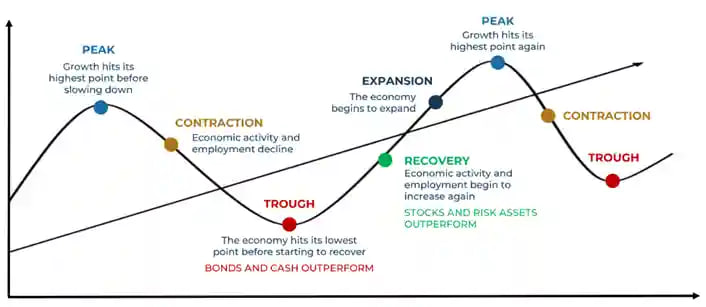
History shows that market cycles are inevitable but
temporary. Over the past century, every recession has been
followed by recovery and growth. If that’s true, why not
sell when things look bad and buy back when things
improve? The challenge is that markets move ahead of the
economic cycle and often rebound before recovery is
confirmed. Every recession looks obvious in hindsight, but
in real time, even experts struggle to call the bottom or
the top. In fact, the National Bureau of Economic Research
(NBER), the official arbiter of U.S. recessions, makes its
announcements only after the fact. The committee waits for
revised data and clear evidence before declaring recession
start and end dates, which means those calls come well
after the market has already moved.
Behavioral Finance: Why Emotions Matter
Investing is as much about psychology as it is about
numbers. Emotions like fear and excitement can drive
investors to make poor decisions, such as buying high when
optimistic or selling low when fearful. Cognitive biases
like confirmation bias, mental accounting, and recency
bias can cloud judgment and lead to suboptimal
outcomes.
•Confirmation Bias: Seeking information that supports your
beliefs.
Example: You strongly believe tech stocks will outperform,
so you only read bullish articles and ignore reports
warning of risks.
•Mental Accounting: Treating money differently based on
its source.
Example: You receive a $2,000 tax refund and splurge on a
vacation because it feels like “extra” money, even though
it’s part of your ordinary income.
•Recency Bias: Assuming current trends will continue
indefinitely.
Example: After a year of strong stock gains, you assume
the rally will keep going and increase your equity
exposure aggressively, forgetting that markets move in
cycles.
Awareness of these behavioral biases is the first step
toward making better financial decisions. Emotions can
lead investors to react in ways that hurt long-term
results, such as selling when markets fall and buying only
after prices recover. Working with a financial advisor and
having a disciplined plan helps you stay on track and
avoid costly mistakes.
Bringing It All Together
Understanding these concepts helps you:
•Set realistic expectations: Markets will rise and fall,
and that’s completely normal. Staying focused on the long
term helps you avoid reacting to short-term noise.
•Diversify wisely: Don’t rely on one part of the market.
Different assets perform better in different phases of the
economic cycle, so a balanced mix can help reduce risk and
smooth returns.
•Partner with your advisor: Investing isn’t just about
numbers; it involves emotions too. A trusted advisor can
help you stay disciplined, recognize cognitive traps, and
keep your plan aligned with your goals and comfort
level.